Let’s imagine this…
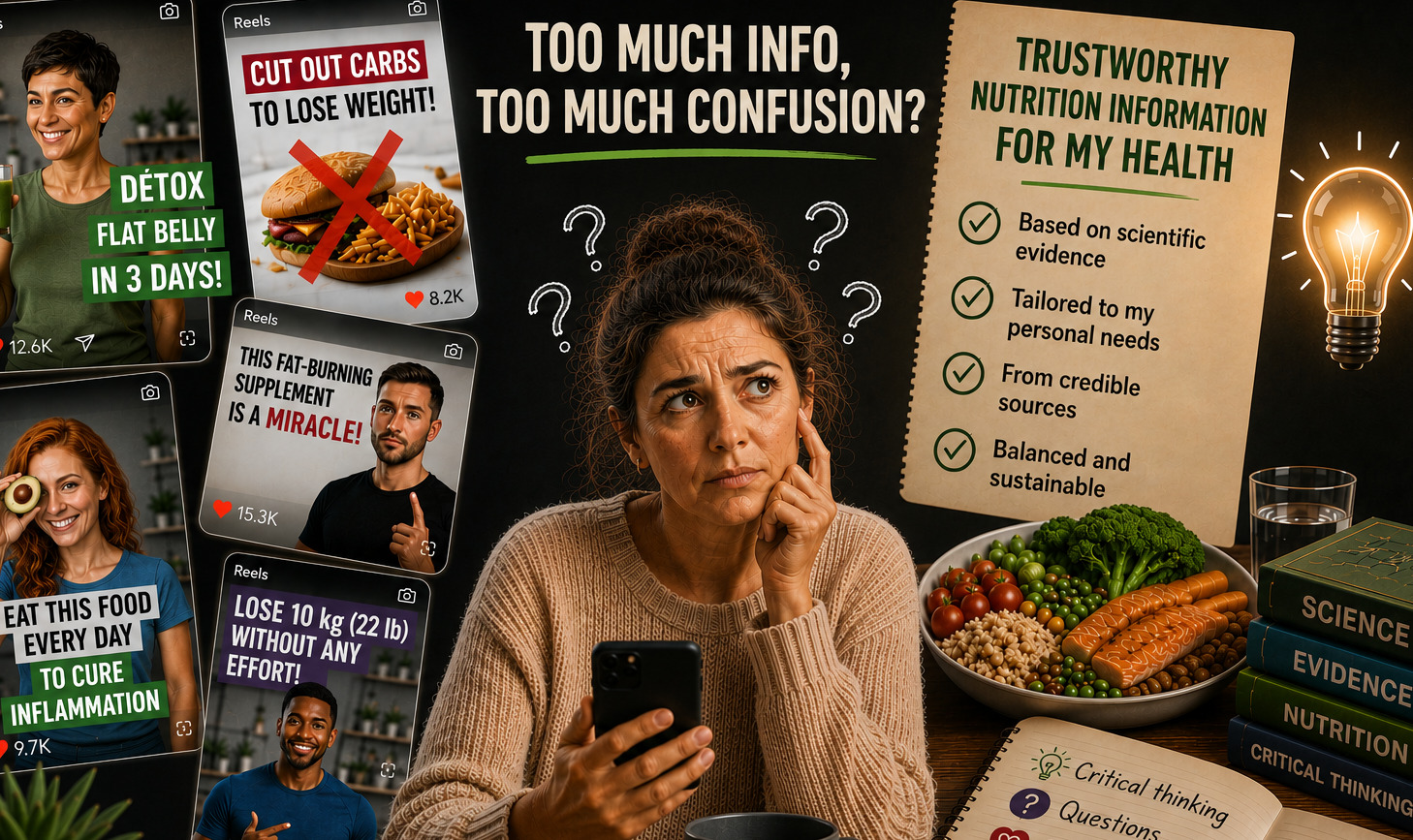
We open our phone for a few minutes, a recipe appears, then an influencer explains which foods to eliminate. A few seconds later, another says exactly the opposite. Then someone promises to effortlessly lose 10 pounds or cure our inflammation with one single food.
In less than five minutes, we received more nutritional advice than we did twenty years ago in an entire year.
But one question remains: how much of this advice is personalized and really based on scientific data… And how many are simply based on opinions, marketing or click-finding?
Today, I propose that we learn to differentiate between credible nutritional information and content that can, at times, harm our health.
Here is the radio interview in which journalist Adrien Blanc and his Radio-Canada team invited me to participate, in order to help them see things more clearly.
Please click here for the radio interview
As well as the written summary of the highlights.
Thank you for your interest in healthy eating and enjoy listening or reading!
And above all “Savour life”!
Your nutritionist and speaker, member of the Ordre des diététistes nutritionniste du Québec, Johanne Vézina, P.Dt.
1. Social media has a strong influence on our diet
- Influencers are having a growing impact on eating habits.
- Algorithms continuously offer nutritional advice, recipes and diets.
- It becomes difficult for the public to distinguish reliable information from false promises.
2. Very few creators are actually qualified
- According to the study led by Dr. Leah Cahill (Dalhousie University, Nova Scotia):
- Less than 25% (22.5%) of the content analyzed came from physicians, dietitians or nutritionists.
- More than three out of four pieces of content are therefore produced by people without recognized training in nutrition.
Note that the most popular tips are not necessarily the most reliable.
3. Nutritional advice should be personalized
A real nutritional consultation conducted by a nutritionist or dietitian who is a member of an order, such as the Ordre des diététistes nutritionnistes du Québec, considers, in particular:
- Diseases;
- Medications;
- Food allergies or intolerances;
- Eating habits;
- Tastes and preferences;
- Cooking skills;
- Lifestyle (budget);
- Health goals.
An influencer usually doesn’t have this information before making a recommendation.
4. The most common false advice
Among the misleading messages found on social networks:
- Miracle diets;
- Fasting or skipping meals;
- Promises of rapid weight loss;
- Detox;
- Miracle foods;
- Unique solutions applicable to everyone.
This advice is often based on little or no scientific evidence.
5. Fasting is not necessary to improve your health
The best current science shows that it is often more effective to:
- Eat more vegetables;
- Eat more fruit;
- Choose whole grains;
- Favor lean protein foods (such as poultry, fish, legumes);
- Adopt good sustainable habits.
Eating better is generally more effective than eating less.
6. There is no such thing as a “superfood”
The term “superfood” is essentially marketing.
In reality:
- No single food cures everything;
- No food is perfect;
- It’s the whole diet that counts.
7. No food is forbidden
A healthy diet allows you to eat everything.
Rather, the objective is to:
- Increase the frequency of nutritious foods;
- Reduce the consumption of ultra-processed foods;
- Preserve the pleasure of eating.
Example: Ice cream can be part of a balanced diet, especially when it is accompanied by seasonal fruits, such as blueberries.
8. People of all ages and particularly young people (teenagers, young adults and sometimes even children) are targeted by influencers.
Companies sometimes use:
- Several or hundreds of influencers to promote 1 product;
- Messages that bear little resemblance to advertising;
- Content specifically designed to attract:
9. Marketing is often disguised
The most frequently promoted products include:
- Sugary drinks;
- Energy drinks;
- Fast food;
- Potato chips;
- Candy.
These promotions often seem like personal recommendations but they are not.
10. How do I recognize credible information?
Before believing any nutritional advice, it is useful to ask yourself:
- Who is speaking?
- What is his training?
- Is he or she a member of a professional order? For example, the Ordre des diététistes nutritionniste du Québec?
- Ask questions
- Take a photo of: the food or product in question, the list of ingredients and the nutritional value table and show it to your nutritionist
- Are the claims based on scientific studies?
- Is there a conflict of interest?
- Is there a sponsorship?
Consulting a nutritionist or dietitian who is a member of a professional order remains the best approach. We can be consulted in person or remotely.
Together we saw that:
1. Popularity is not a guarantee of credibility.
2. A healthy way of eating is not based on miracle diets, but on sustainable habits.
3. Before following any advice seen on social media, check the qualifications of the person giving it.
“Social media can be a great source of inspiration… but they should never replace the personalized advice of a dietitian nutritionist who is a member of a professional order.”